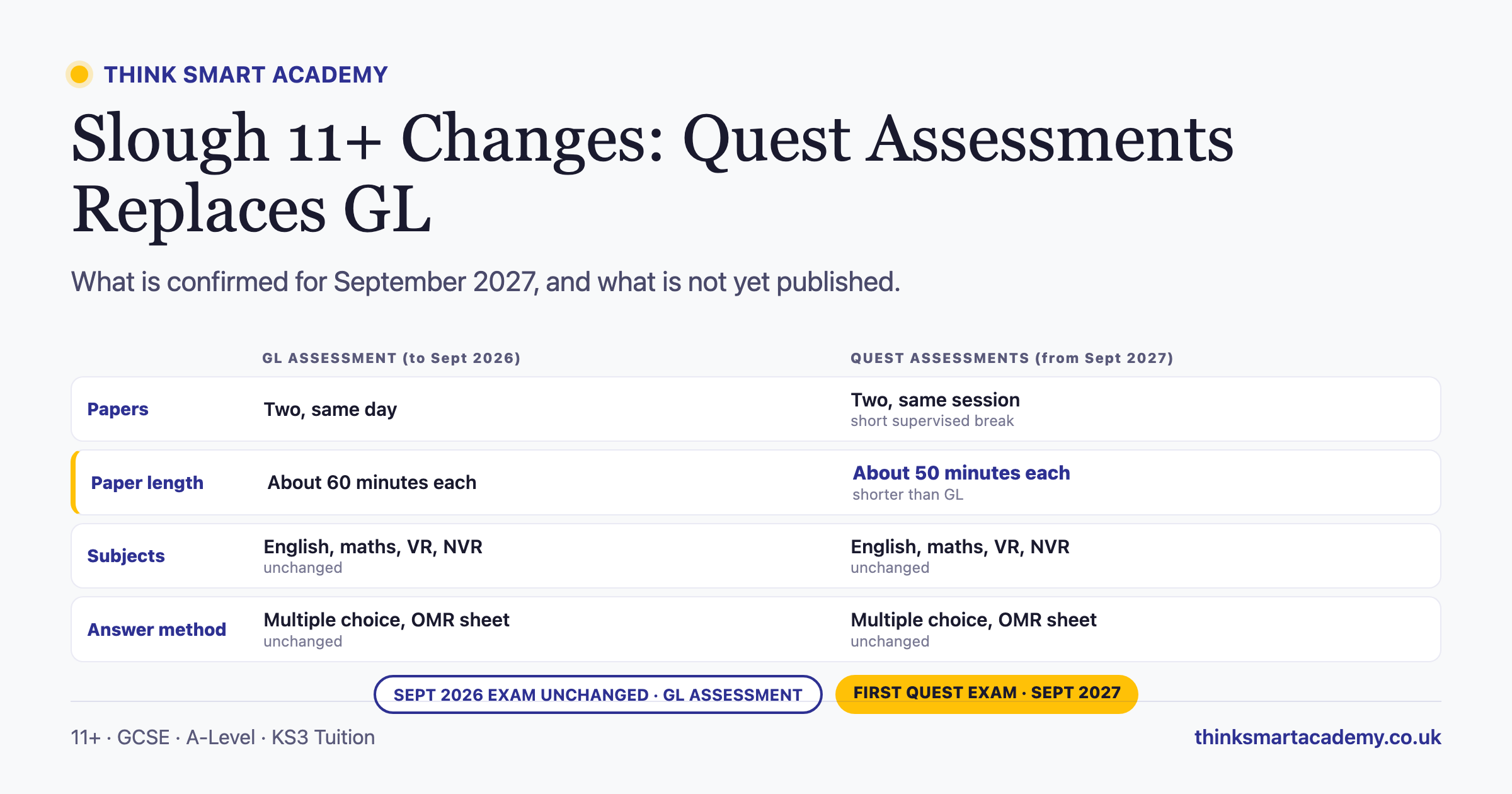
If your child is preparing for the 11+ in Slough, you may have seen news that the exam is changing. On 13 July 2026, the Slough Consortium of Grammar Schools confirmed that its 11+ entrance exam will be run by a new provider, Quest Assessments, from September 2027 onwards. This replaces GL Assessment, which has set the Slough exam since 2023.
This is a genuine change, and it is easy to misread. The most important thing to understand first: the September 2026 exam is not affected. If your child is sitting the 11+ this autumn for entry in September 2027, everything stays exactly as it was. The change applies to a later cohort.
This guide sets out what has been confirmed, who is affected, what we still do not know, and what it means for your child’s preparation. Where a detail has not yet been officially published, we say so plainly rather than guess.
The Headline: What Actually Changed
Grammar school consortiums contract a test provider to write, deliver, and mark the 11+ exam. For years, most used GL Assessment. The Slough Consortium has now decided that from the September 2027 exam onwards, the exam will be provided by Quest Assessments instead.
Here is how the timeline breaks down:
| Exam sat | Provider | For entry to Year 7 in | School year of child now |
|---|---|---|---|
| September 2026 | GL Assessment (no change) | September 2027 | Year 5 |
| September 2027 | Quest Assessments (new) | September 2028 | Year 4 |
| September 2028 onwards | Quest Assessments | September 2029 onwards | Year 3 and below |
In plain terms: children currently in Year 5 sit the familiar GL exam this September. Children currently in Year 4 are the first cohort to sit the new Quest Assessments exam, in September 2027.
Nothing Changes for the September 2026 Exam
This is worth repeating because it is where most of the worry comes from. For the exam sat in September 2026:
- The provider is still GL Assessment.
- The exam is still on Saturday 19 September 2026, as confirmed by the consortium schools.
- Registration ran from 1 May 2026 to 5 June 2026 and is now closed.
- The eligibility score is still 111 on a standardised scale, identifying roughly the top 35% of the cohort as eligible for a grammar school place.
- The four schools are unchanged: Herschel, Langley, St Bernard’s Catholic, and Upton Court.
If your child is in Year 5, prepare exactly as planned. Our full 11+ registration and dates guide still applies to this cycle without amendment.
Who Is Affected, and When
The children affected are those currently in Year 4 (and younger), who will sit the exam in September 2027 for entry in September 2028.
According to Quest Assessments’ own published guidance for the Slough Consortium, registration for that first Quest exam is expected to open in May 2027, with the exam in September 2027 and results in mid-October 2027, following the established pattern. These dates will be confirmed officially closer to the time.
If your child is in Year 4 now, this is the cohort to watch. It does not mean starting again or panicking; as we explain below, the foundations of good 11+ preparation are the same regardless of provider.
What Is Quest Assessments, and How Different Is the Exam?
Quest Assessments is an established 11+ exam provider that a number of grammar school areas have moved to recently. Bexley’s grammar schools, for example, announced their own move from GL Assessment to Quest earlier in 2026, so Slough is not the only consortium making this switch.
Based on Quest Assessments’ published guidance for the Slough Consortium, the structure of the new exam looks broadly familiar to anyone who knows the current GL format:
| Feature | Current GL exam (to Sept 2026) | New Quest exam (from Sept 2027) |
|---|---|---|
| Number of papers | Two, same day | Two, same session with a short supervised break |
| Paper length | About 60 minutes each | About 50 minutes each |
| Paper 1 | Verbal skills (English, verbal reasoning) | English comprehension and verbal reasoning |
| Paper 2 | Non-verbal skills (non-verbal reasoning, maths) | Non-verbal reasoning and maths |
| Answer method | Multiple choice on a separate answer sheet (OMR) | Multiple choice on a separate answer sheet (OMR) |
| Subjects assessed | English, maths, verbal reasoning, non-verbal reasoning | English, maths, verbal reasoning, non-verbal reasoning |
So the same four subject areas are tested, in two multiple-choice papers marked by machine, sat in a single morning. The most visible differences in the published material are the slightly shorter paper length (around 50 minutes rather than 60) and the provider’s own familiarisation materials.
Quest describes the best preparation as “a strong grounding in school learning, combined with wide reading and the ability to apply knowledge to new contexts.” That is a helpful signal for parents: the emphasis is on genuine understanding and reading, not on memorising tricks for one provider’s question style.
Quest also says it will provide free familiarisation booklets covering each subject, plus guidance for children, reading lists, and vocabulary lists. When those are released, they become the single most reliable guide to exactly what the new papers look like.
What We Still Do Not Know
We would rather be honest than fill this page with detail that has not been published. As of 18 July 2026, the following are not yet officially confirmed for the Quest exam:
- The exact number of questions per paper.
- The precise weighting between subjects (whether, for example, verbal skills carry more marks than non-verbal).
- Whether the qualifying score will remain 111, or be set on a different scale.
- The exact 2027 registration and exam dates (May and September 2027 are expected, based on the usual pattern and Quest’s guidance, but not yet formally fixed).
- The full content and format of Quest’s familiarisation papers.
Parents who registered a child for the current cycle have been told to watch the consortium’s online portal for further information through the summer of 2026. We will update this article as official details are published. Treat any figure not confirmed by the consortium or Quest Assessments directly as provisional.
Is This Part of a Bigger National Trend?
Yes, and it helps to see the Slough change in context. Several grammar school areas are moving away from GL Assessment at the same time:
- Bexley announced a move from GL Assessment to Quest Assessments earlier in 2026.
- Trafford’s grammar schools announced in July 2026 that they will move from GL Assessment to a different provider, Future Stories Community Enterprise (FSCE), bringing in a new curriculum-based test for entry from 2028, and moving the exam earlier (to the summer term of Year 5) from 2029 entry onwards.
The common thread is a shift away from a single dominant provider and, in some areas, towards tests grounded more closely in the Key Stage 2 curriculum. Slough’s move to Quest keeps the familiar four-subject, two-paper structure, so it is a more modest change than Trafford’s. But the direction of travel nationally is clear: the 11+ landscape is being reshuffled, and it pays to check the specific arrangements for your own consortium rather than assume they are the same everywhere.
Does This Affect Buckinghamshire and High Wycombe?
No. If you are in Buckinghamshire (High Wycombe, Marlow, Beaconsfield, Amersham), your child sits the Buckinghamshire Secondary Transfer Test (STT), which is a separate system administered by Buckinghamshire Council.
For the 2026 cycle, Buckinghamshire’s arrangements are unchanged and still use GL Assessment:
- Test dates: 8 and 10 September 2026 (with a familiarisation practice test on 8 September).
- Registration: opened 1 May 2026, closed 2 June 2026.
- Results: after 4pm on 9 October 2026.
- Qualifying score: 121 on a standardised scale.
We have not found any announcement that Buckinghamshire is changing its provider. The Slough Consortium’s move to Quest Assessments applies only to the four Slough grammar schools. If you are preparing for both areas, our Slough and High Wycombe 11+ pages set out each system separately.
What Parents Should Do Now
The practical advice depends on your child’s year group.
If your child is in Year 5 (sitting the exam in September 2026)
Nothing changes. Keep preparing for the GL Assessment exam on Saturday 19 September 2026. Focus on:
- Timed practice under exam conditions to build stamina.
- Full GL-style practice papers across all four subjects.
- Confidence in the final weeks, not last-minute cramming.
Everything in our registration and preparation timeline still holds for this cycle.
If your child is in Year 4 (first Quest cohort, September 2027)
There is no need to change course, and certainly no need to worry. Because the new exam tests the same four subjects and rewards genuine understanding and wide reading, strong preparation now is not wasted, it is exactly what the Quest exam asks for. Sensible steps:
- Keep building core skills: reading comprehension, mental arithmetic, vocabulary, and reasoning fundamentals. These transfer across any provider.
- Prioritise wide reading, which Quest explicitly highlights as the best preparation.
- Watch for Quest’s free familiarisation booklets, and switch to practising in the exact new format once they are released.
- Avoid stockpiling large volumes of GL-only practice material for this cohort until the new format is clearer.
For every parent
The single most useful thing you can do is check the source, not the rumour. When a provider changes, a lot of second-hand and out-of-date advice circulates. Rely on the consortium’s own portal, the individual grammar schools’ admissions pages, and Quest Assessments’ published guidance, and treat everything else as needing confirmation.
How Think Smart Academy Is Responding
We prepare children for both the Slough Consortium and Buckinghamshire systems at our Slough and High Wycombe centres, and we are following the transition to Quest Assessments closely.
Our approach was never built on drilling one provider’s question tricks. It is built on genuine subject mastery across maths, English, verbal reasoning, and non-verbal reasoning, the exact foundation the new Quest exam rewards. As official Quest materials are released, we will fold the specific format into our teaching and mock exams so that students preparing for the September 2027 exam practise in the right style.
If you are unsure which cycle your child falls into, or how to prepare for the transition, the best starting point is a free diagnostic assessment. We will test your child across all four 11+ subjects, tell you where they stand, and recommend a plan built around their year group and target schools.
Sources: the Slough Consortium’s 13 July 2026 announcement, Quest Assessments’ published parent guidance for the Slough Consortium, the Slough grammar schools’ own 2027 admissions pages, and Buckinghamshire Council’s Secondary Transfer Test information. Dates and details for the September 2027 Quest exam are expected but not yet formally confirmed, and are labelled as such above. This article was published on 18 July 2026 and will be updated as the consortium and Quest Assessments publish further detail.